Headstone Inscription Ideas & 'In Loving Memory' Quotes
Gentle headstone inscription ideas, from short 'in loving memory' lines to epitaphs for a mother, father or grandparent, plus what to check.

On this page
Choosing the words for a headstone is a tender task, made harder by knowing they will stand for a very long time. You want something true to the person, something that will still feel right in fifty years, and something that fits the space you have. This guide gathers gentle ideas, from short “in loving memory” lines to longer epitaphs, with a little practical help on choosing.
There is no single right inscription. The best ones are often the simplest: a name, the dates, and a few honest words that say how loved the person was.
Key takeaways
- Shorter is usually better. Stone has limited room, and simple lines age well.
- A typical inscription has an opening line, the name and dates, and a closing line.
- Read it aloud and picture it in twenty years before you decide.
- Check your cemetery’s rules on length, wording and symbols before ordering.
- You can add a QR code so the stone links to their fuller story online.
What to include on a headstone
Before the wording, it helps to know the usual parts. Most inscriptions are built from a few of these, and you do not need all of them:
- An opening line, such as “In loving memory of” or “Treasured memories of”.
- The person’s full name, and often the name they were known by.
- Their dates, or simply the years.
- A word about who they were: “a loving mother, grandmother and friend”.
- A short closing line, verse or quotation.
Lead with the relationship that mattered most, and let the rest fall away. A stone does not need to list everything to say everything.
Short “in loving memory” lines
These classic openings need no improving, and they fit almost any marker:
- In loving memory
- Forever in our hearts
- Always loved, never forgotten
- Treasured memories
- Until we meet again
- Loved beyond words, missed beyond measure
- Gone from our sight, never from our hearts
Short epitaphs and closing lines
A closing line beneath the name and dates adds warmth without taking much room:
- A life beautifully lived, a heart deeply loved
- She lit up every room she entered
- A loving mother, grandmother and friend
- Rest gently
- Reunited
- His kindness lives on in us
- Loved by all who knew him
Inscriptions for a particular person
It helps to lead with their role, or their nature. A few starting points:
| For a… | A gentle inscription |
|---|---|
| Mother | “A devoted mother whose love still surrounds us” |
| Father | “A good man, a steady hand, deeply loved” |
| Grandparent | “Treasured memories of a much loved Nana” |
| Husband or wife | “Together always, in this life and the next” |
| Child | “Held for a moment, loved for a lifetime” |
Lines from faith, poetry and song
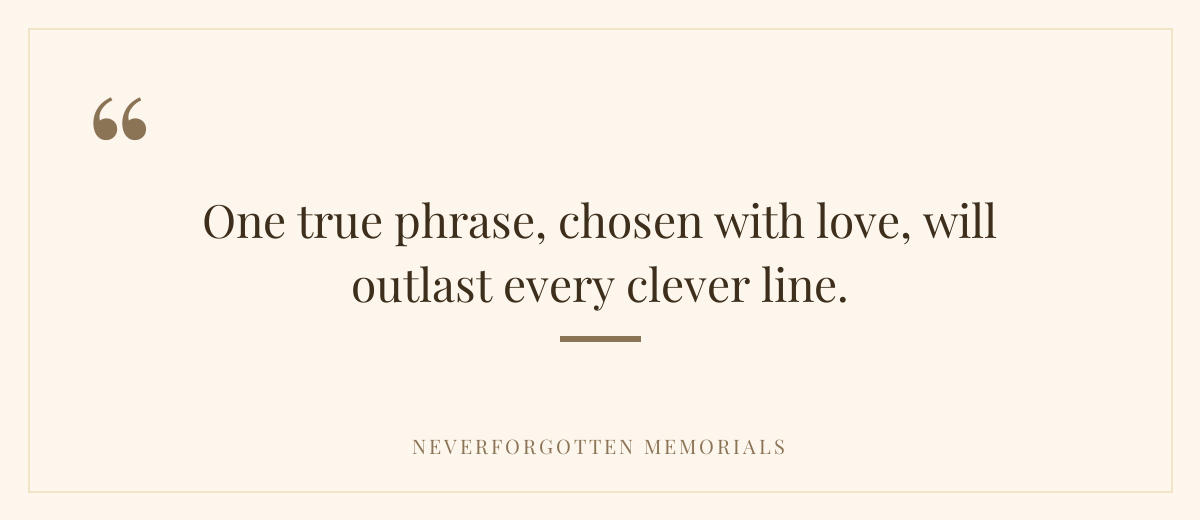
Many families draw on a line of scripture, a poem or a lyric the person loved. Familiar choices include “Safe in the arms of God”, “The Lord is my shepherd”, “Forever young”, or a phrase from a favourite hymn. If you use a quotation, keep it short, and choose words that meant something to them rather than the grandest line you can find. One true phrase will always outlast a clever one.
Practical things to check before you order
A few gentle, practical points can save heartache later:
- Count the characters. Stonemasons charge by the letter, and space is limited. Shorter lines are also easier to read from a distance.
- Check the cemetery’s rules. Many have guidance on length, wording, language and symbols, especially in older or church graveyards.
- Read it aloud, and sleep on it. Words chosen in early grief sometimes feel different months later.
- Consider the whole family. If others will share the plot one day, leave room.
Letting the stone tell the whole story
A headstone holds a name, two dates and a line or two of love. A whole life asks for more room than that. This is why many families now add a small QR code to the stone, linking it to an online memorial where the photos, stories and tributes live. A visitor can read the inscription, then scan to meet the person behind it. Our guide to QR codes for headstones explains how that works, and our meaningful ways to remember a loved one has more gentle ideas.
Take your time with the words. The right ones are not the most poetic, but the most true. Chosen with love, a few simple lines will say everything.
Last updated 6 Jul 2026
Frequently asked questions
What do you write on a headstone?
Most inscriptions have an opening line such as ‘In loving memory’, the person’s name and dates, and a short closing line about who they were. Simple, true words age best. Check your cemetery’s rules on length and wording first.
What are good short headstone quotes?
Gentle favourites include ‘Forever in our hearts’, ‘Always loved, never forgotten’, ‘Until we meet again’, ‘Rest gently’ and ‘Treasured memories’. Short lines are easier to read and leave room on the stone.
How many words should be on a headstone?
There’s no fixed number, but shorter is usually better. Stonemasons charge by the letter, space is limited, and brief lines read more clearly. Many use just an opening line, the name and dates, and one closing line.
Can you add a QR code to a headstone?
Yes. A weatherproof QR plaque can link the stone to an online memorial of photos, stories and tributes, so visitors can scan to read the fuller story. Check your cemetery’s rules before fixing anything to the stone.
Related reading
Memorial Anniversary Ideas: Honouring a Loved One on Special Days
Comforting ways to mark a birthday, death anniversary or holiday — from quiet rituals to gatherings with family.
 Guide
Meaningful Ways to Remember a Loved One Who Has Passed
Gentle, meaningful ideas for keeping a loved one's memory close — from everyday rituals to lasting tributes.
Stay gently in touch
Occasional, compassionate guidance on remembrance and creating a lasting memorial. No noise. Unsubscribe any time.
Share a thought (0)
No account needed. Your words may bring comfort to someone else reading this.