The First Year of Grief: What to Expect and How to Cope
A gentle, honest guide to the first year of grief: what the early weeks can feel like, how to face the firsts, and the small things that truly help.

On this page
If you have lost someone you love, the first year of grief can feel like a country you never chose to visit. Nothing is quite where it used to be, even the ordinary things. So let this be the first thing you read here: there is no right way to grieve, and there is no wrong way either. Grief does not follow a timetable, and it does not move in tidy stages. It comes in waves. Some days you will manage better than you expected. Some days a song on the radio will undo you at the kitchen sink. Both are normal, and neither one means you are doing this badly.
This guide walks gently through what the first year often holds, from the fog of the early weeks to the first Christmas and the first anniversary, with small, honest things that genuinely help.
Key takeaways
- Grief comes in waves, not stages. Skipping a “stage” means nothing is wrong with you.
- The early weeks are often numb and busy. Many people feel the loss more, not less, once the visitors go home.
- The firsts (birthday, Christmas, the anniversary) are gentler with a small plan made in advance.
- Guard the basics: eat something, rest when you can, get a little air every day.
- If grief feels unmanageable, talking to your GP or a bereavement counsellor is strength, not weakness.
What the early weeks can feel like
In Ireland, the days around a funeral are full. The house fills with neighbours and sandwiches, the kettle never quite goes cold, and there are decisions to make about readings and flowers and who is carrying what. That busyness holds people up like scaffolding.
Then the funeral ends, everyone goes home, and the house goes quiet. For many people this is when grief really begins, and it can arrive in ways nobody warns you about:
- Numbness. Feeling strangely fine, or feeling nothing at all, and worrying that this means you didn’t love them enough. It doesn’t. Numbness is the mind’s way of taking the pain in small doses.
- Fog. Forgetting why you walked into a room. Losing your keys, your words, whole afternoons. Grief takes up enormous space in the mind, and for a while there is less room for everything else.
- A tired body. Grief is physical. It can affect sleep, appetite and energy, and leave you aching like you’ve carried something heavy. You have.
- Unexpected feelings. Relief, especially after a long illness, and then guilt about the relief. Laughing at something and feeling you’ve betrayed them. Anger at the person for leaving, which can frighten people most of all.
Every one of these is a normal part of grieving. You are not doing it wrong.
Do the five stages of grief happen in order?
Most people have heard of the five stages: denial, anger, bargaining, depression and acceptance. What is less well known is that they were never written as a map for bereaved families to follow, and real grief rarely moves in a straight line through them.
It is more honest to say grief comes in waves and loops. You might feel acceptance on Tuesday and fury on Friday. You might feel two things at once that seem to contradict each other, missing them terribly while also feeling moments of real peace. If your grief doesn’t match a diagram, there is nothing wrong with your grief. The diagram was only ever a rough sketch of something far too personal to chart.
How long does grief last?
There is no timetable, and anyone who gives you one is guessing. But two honest things are worth knowing.
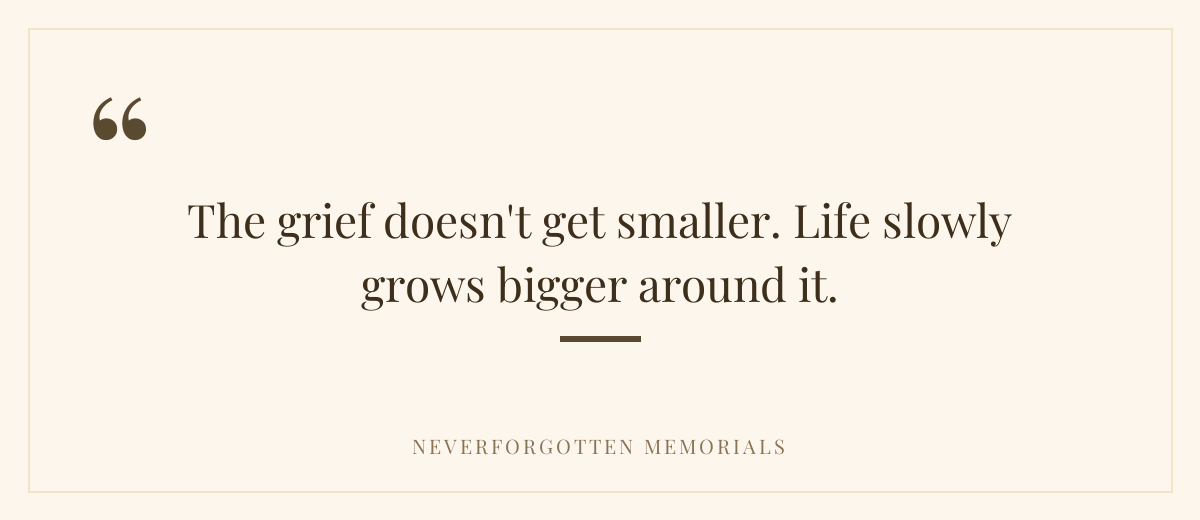
The first is that grief usually softens rather than ends. You loved them, and love doesn’t stop, so the missing doesn’t stop either. What changes, slowly, is the sharpness. Many people say the grief never got smaller at all; their life gradually grew bigger around it. There is room in a life for grief and joy together, though it takes time to believe that.
The second is that the low point often comes later than people expect. The early weeks are cushioned by shock and company. A few months on, the cards stop, the phone goes quieter, and the world seems to expect you back to normal, right when the reality is settling in deepest. If you feel worse in month four than you did at the funeral, you are not going backwards. You are grieving, and this is simply how it moves.
The first year of grief is a year of firsts
The first birthday without them. The first Christmas. The first anniversary of the day they died. Two things help with almost all of these days. Make a small plan, even a very simple one, because the dread beforehand is usually worse than the day itself. And tell someone the date is coming, so you don’t have to carry it alone.
| The first… | What can help |
|---|---|
| Month’s Mind | In Ireland, a memorial Mass is often held about a month after the death. It gathers everyone again, more quietly this time, and can be a gentle marker in a blurry month. |
| Their birthday | Light a candle, cook their favourite dinner, or gather a few people to share stories. Small and true beats big and brave. |
| Christmas and holidays | Decide in advance what you’ll keep, what you’ll skip and what you’ll change. Give yourself permission to leave early, or to enjoy it. Both honour them. |
| The first anniversary | Plan it like it matters, because it does. Visit the grave, walk somewhere they loved, look at photographs together, or add new stories to their memorial page. |
| The ordinary days | Some days ambush you: their handwriting on a list, a smell, their song playing in a shop. No plan covers these. Be extra kind to yourself when they come. |
There are more gentle ideas for these days in our guide to memorial anniversary ideas.
Small things that genuinely help
None of these fix grief. Nothing fixes grief, because it isn’t a problem to be solved. But each of these makes the carrying a little easier.
- Say their name, and let others say it. People sometimes avoid mentioning the person for fear of upsetting you, as if you might otherwise forget. You won’t. Most grieving people ache to hear the name said out loud.
- Accept specific help, and ask for it. “Let me know if you need anything” is kindly meant and hard to use. When someone offers, tell them the actual thing: the school run on Thursday, a lift to the Month’s Mind, dinner on the bad day.
- Keep a gentle routine. Regular meals, a short walk, a reasonable bedtime. And where you can, avoid making big, irreversible decisions in the first year. Grief is not the ground to build on just yet.
- Write things down. Memories surface and slip away again, and the fear of losing them is its own quiet grief. Some people keep a notebook or a memory box. Some families gather everything in one place, an online memorial where everyone can add their photos and stories, so no single person has to be the keeper of them all.
- Let the tears come when they come. Crying is not a setback and composure is not progress. There are more ways to keep someone close in our guide to meaningful ways to remember a loved one.
When to reach out for more support
Grief is not an illness, and most of what you are feeling, however fierce, is love doing what love does after a loss. But sometimes grief needs more company than family and friends can give, and that is nothing to be ashamed of.
Consider talking to your GP or a bereavement counsellor if the months are passing and nothing is softening at all, if you are struggling to manage everyday life, or if you are having thoughts of harming yourself. In Ireland, organisations such as the Irish Hospice Foundation offer bereavement support, and your GP can connect you with services near you. Reaching out is not weakness. It may be the bravest thing a grieving person can do, and the person you are missing would want you to have that help.
Carrying them with you
The first year asks something enormous of you: to keep living ordinary days while learning to carry an extraordinary absence. Be gentle with yourself about how imperfectly that goes. There is no deadline waiting at the twelve month mark, and no prize for grieving quietly.
And when you are ready, remembering is part of coping. Telling their stories, looking at their photographs, hearing their name. However you choose to do that, in a notebook, at the graveside, or on a memorial page the whole family can visit, the love you are carrying deserves somewhere to live.
Be gentle with yourself. You are doing something enormous, one ordinary day at a time.
Frequently asked questions
Is the first year of grief the hardest?
It is often the hardest because everything is a first: the first birthday, the first Christmas, the first anniversary. But grief has no fixed shape. Some people struggle more in the second year, when the world stops asking. However it unfolds for you is normal.
Is it normal to feel worse a few months after the funeral?
Yes, very. The early weeks are numb and busy with arrangements and visitors. A few months on, the support quietens down just as the reality settles in. Feeling worse then does not mean you are going backwards. It means you are grieving.
What is a Month's Mind?
A Month’s Mind is an Irish tradition: a memorial Mass held around a month after someone’s death. Family and friends gather again, more quietly this time. Many families find it a gentle marker, and a moment to see how everyone is really doing.
When should I get help with my grief?
If your grief is not softening at all, if daily life feels unmanageable, or if you are having thoughts of harming yourself, talk to your GP or a bereavement counsellor. Reaching out is not weakness. It is one of the bravest things a grieving person can do.
Stay gently in touch
Occasional, compassionate guidance on remembrance and creating a lasting memorial. No noise. Unsubscribe any time.
Share a thought (0)
No account needed. Your words may bring comfort to someone else reading this.